
In a custom home builder vs general contractor comparison, the key difference is often not who can oversee construction, but who helps shape the plan and when they join the process. Both roles can coordinate building work. The right fit depends on whether you are starting with an idea, have completed plans, or are remodeling an existing home.
The titles can feel interchangeable because responsibilities overlap. What matters is how planning, material choices, construction management, and communication fit together. A clear understanding of those responsibilities helps you choose an approach that suits your project and keeps decisions connected to your vision.
This guide explains where the roles differ, what to compare, and how to decide what kind of support you need. For homeowners in Duvall and nearby Seattle Eastside communities, TimberworX brings concept development and construction management together, creating continuity from early decisions through the build.
Key Takeaways
- In the custom home builder vs general contractor decision, focus on who will shape the plan and carry it through construction, not just the job title.
- A ground-up home and a remodel have different starting points. Match the project team’s scope to the work you are planning.
- Clarify who coordinates planning, construction management, material selections, and communication so decisions stay connected as work progresses.
- An integrated design-build approach can link early concepts with construction and help keep the finished space aligned with your vision.
Section 1
To understand the custom home builder vs general contractor distinction, look at when each partner enters the project and what they coordinate. A custom home builder typically focuses on creating a new residence around the homeowner’s needs, guiding decisions from early planning through construction—an approach exemplified by specialized builders such as Vancouver Custom Homes. A general contractor typically manages construction work across different project types and may join once plans are ready. The roles can overlap, so the project’s scope and delivery approach matter more than the title alone.
A general contractor organizes work on site, coordinating trades, materials, and the sequence of construction. The General Contractor on Wikipedia offers a foundational overview of the role. A custom home builder may also oversee those practical details while connecting early concepts and material choices to the home taking shape. When comparing approaches, find out who is responsible for each decision and how questions or changes will be communicated.
Consider a homeowner with a complete set of plans for a new home. A team focused on construction management may be well suited to carrying those plans into execution. If the layout, finishes, and broader vision are still developing, a partner involved earlier can help connect those decisions with the build. A remodel starts from a different place: the project must account for the existing home as well as the planned changes.
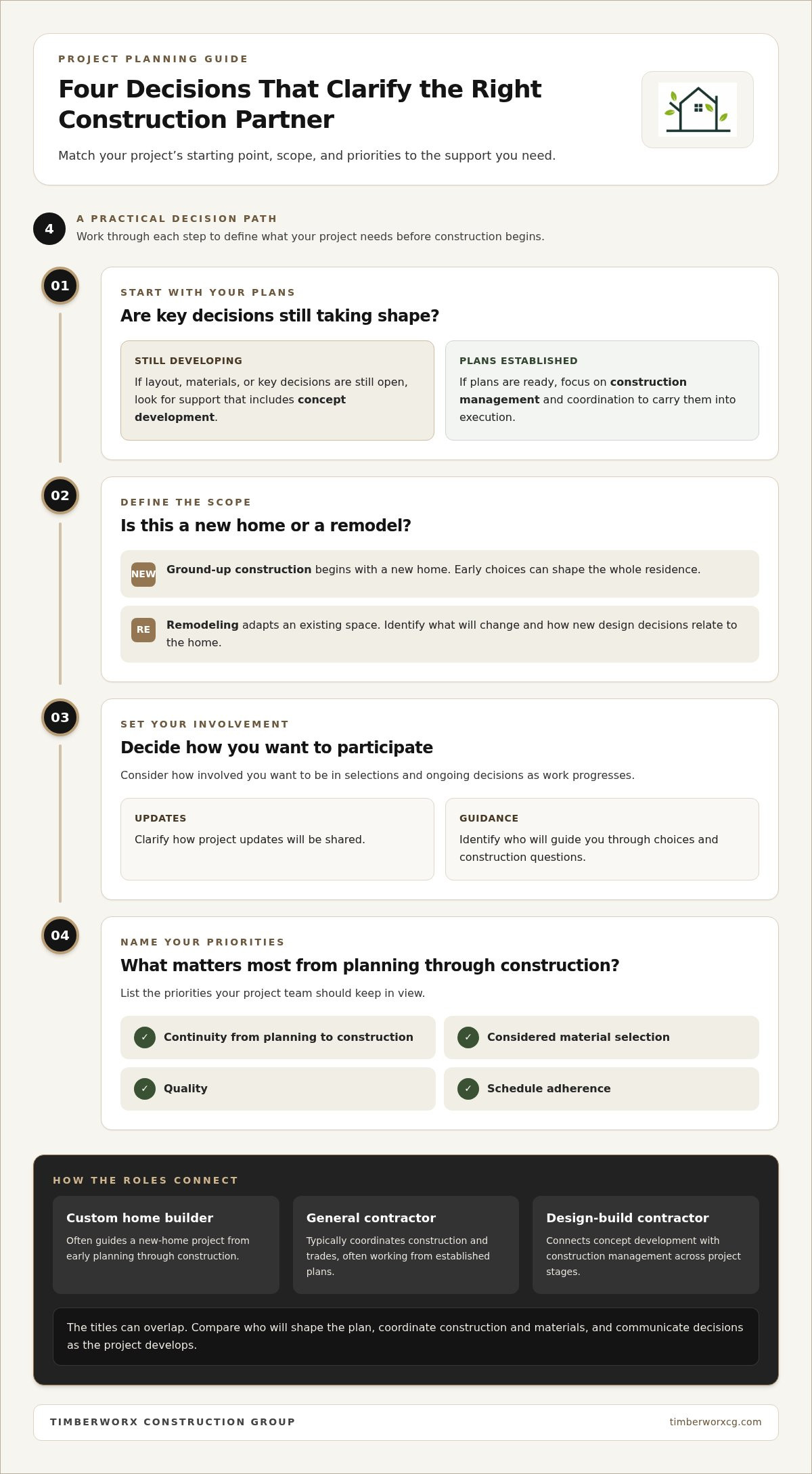
- Custom home builder: Often guides a new-home project from early planning through construction.
- General contractor: Typically coordinates construction and trades, often working from established plans.
- Design-build contractor: Connects concept development with construction management across project stages.
TimberworX Construction Group combines concept development and construction management for new construction and high-end remodels in Duvall, Redmond, Woodinville, Kirkland, Sammamish, Bellevue, and Bothell. This integrated approach connects design intent, material decisions, and construction as the project develops.
Section 2
Once you understand where the roles overlap, compare your project’s readiness with the guidance you want. The custom home builder vs general contractor decision is about more than choosing a title. Consider how much coordination you need before construction begins and how decisions should move from concept to completion.
Use these prompts to define the right fit for your project:
- Your plans: If the layout, materials, and key decisions are still taking shape, look for an approach that includes concept development. If plans are established, focus on construction management and coordination.
- Your scope: Ground-up construction begins with a new home, while remodeling adapts an existing space. Identify which areas will change and how design decisions relate to the construction work.
- Your involvement: Decide how much you want to participate in selections and ongoing decisions. Ask how updates will be shared and who will guide you through choices as work progresses.
- Your priorities: List what matters most, such as continuity from planning through construction, considered material selection, quality, or schedule adherence.
These questions help clarify whether you need a team focused on executing an established plan or one that can guide early decisions as well as construction. They also reveal where coordination will matter most. In a remodel, for example, new finishes need to work with the existing home. In new construction, early choices help shape the whole residence.
TimberworX Construction Group combines concept development with construction management for residential projects in Duvall, Redmond, Woodinville, Kirkland, Sammamish, Bellevue, and Bothell. Bringing planning and execution together helps homeowners carry a considered vision into the build, with clear communication and attention to quality.
Give Your Project a Clear Starting Point
Before moving forward, write down what you want the finished space to make possible, which decisions are still open, and how involved you want to be during construction. Then identify who you expect to guide planning, coordinate materials and trades, and communicate progress. These notes turn the custom home builder vs general contractor question into a practical discussion about the support your project needs.
TimberworX Construction Group is a Duvall-based design-build contractor serving communities across the Seattle Eastside. Its residential work includes concept development, new construction management, and high-end remodeling. The process emphasizes quality, schedule adherence, and clear communication, keeping your vision in view as plans become a finished space.
Start with a clear picture of what matters most to you. Explore TimberworX's construction approach to see how concept development and construction management can support your project.
Frequently Asked Questions
Can a general contractor build a custom home?
Yes. A general contractor can manage a custom home build when that work is part of the project scope. In the custom home builder vs general contractor decision, clarify who will coordinate trades, manage material selections, and resolve construction questions. If you are choosing finishes while work is underway, for example, find out who will guide the decision and explain how it connects to the project.
Is a custom home builder always a separate company from the general contractor?
No. The titles do not necessarily mean you will work with two different companies. One construction team can take on custom-home and general contracting responsibilities, with planning and site coordination handled as parts of the same project. The practical question is how those responsibilities connect. A clear point of contact and decision-making process make it easier to understand who is handling each part.
How should I compare a builder's and general contractor's project proposals?
Compare proposals using the same project assumptions, then note what each includes. Look for who coordinates trades, how material selections are documented, who communicates updates, and how proposed changes are reviewed. A side-by-side comparison can reveal differences that a title will not. One proposal, for instance, may describe planning support in detail, while another focuses on construction execution.
Can one construction team handle both a remodel and a new home?
Yes. A team can handle both when its project scope includes each type of work. TimberworX serves homeowners with custom remodeling and new construction in Duvall, Redmond, Woodinville, Kirkland, Sammamish, Bellevue, and Bothell. A remodel works within an existing property, while a new home starts with a different set of site, concept, and material decisions to coordinate.


